13 results
Loop engineering automates prompts, but without a human feedback interface, an autonomous loop is a black box. KittyClaw was built to fill exactly that gap.
An LLM writes the tile once, the refresh runs without tokens. And the output feeds both the human and the agents. The economics of an agentic dashboard.
Memory, tools, orchestration, the act-observe loop: understanding agentic AI in depth, for developers who want to go beyond the prompt.
Uncontrolled parallelism, memory that resists pivots, flying blind: the three traps of agentic systems and how to anticipate them before they become expensive.
Concrete architecture for maintaining a steady cadence across parallel projects: automations.json, agent memory, and cross-project knowledge compounding.
One week in production: 20 tickets, 12 automations, 6 active agents. Real numbers, genuine surprises, and what we'd do differently.
Between the moment I create a ticket in KittyClaw and the moment Claude starts working, three seconds pass. Here's what happens in the gap.
KittyClaw started as a board to track my agents. In two weeks, it became what triggers them. A shift small in code, big in consequences.
A week after shipping KittyClaw, I added several features. None were planned. Here's what it changes to own your own tool.
Deep dive into Aekan's dispatcher: a Node.js engine that drives 13 Claude agents autonomously, with learning, evaluation, and automatic coordination.
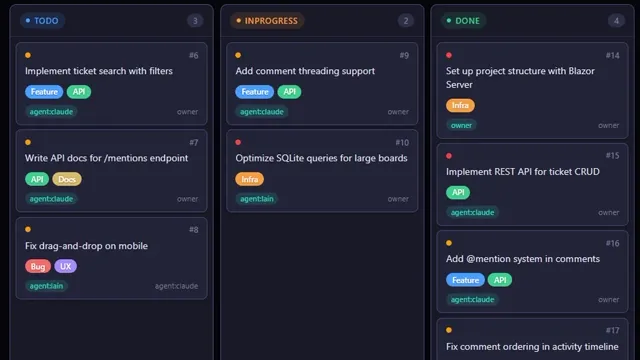
KittyClaw is an open-source kanban where AI agents create tickets, move them and comment - no human clicks. Here's how and why I built it.
Local kanban that orchestrates your Claude Code agents. Create a ticket, an automation engine fires the right agent, streams its output into the board, commits its work.
UPM packages for Unity: GOAP, Wave Function Collapse, Unity Agent Bridge, Flow System and more.