
Agentic systems have a property that sneaks up on you: they spiral easily, and the damage is often invisible until suddenly it isn't. After several months running projects with autonomous agents in parallel, I've identified three recurring patterns. None of them are obvious in advance. All of them are obvious in retrospect.
Three live projects feed this piece: Bloomii, a constructive-journalism media outlet covering social and environmental alternatives; Kalceo, a regulatory B2B SaaS for French construction contractors; and Ekioo, the agent-fleet R&D project behind this article. All three run on KittyClaw, a kanban orchestrator for AI agents.
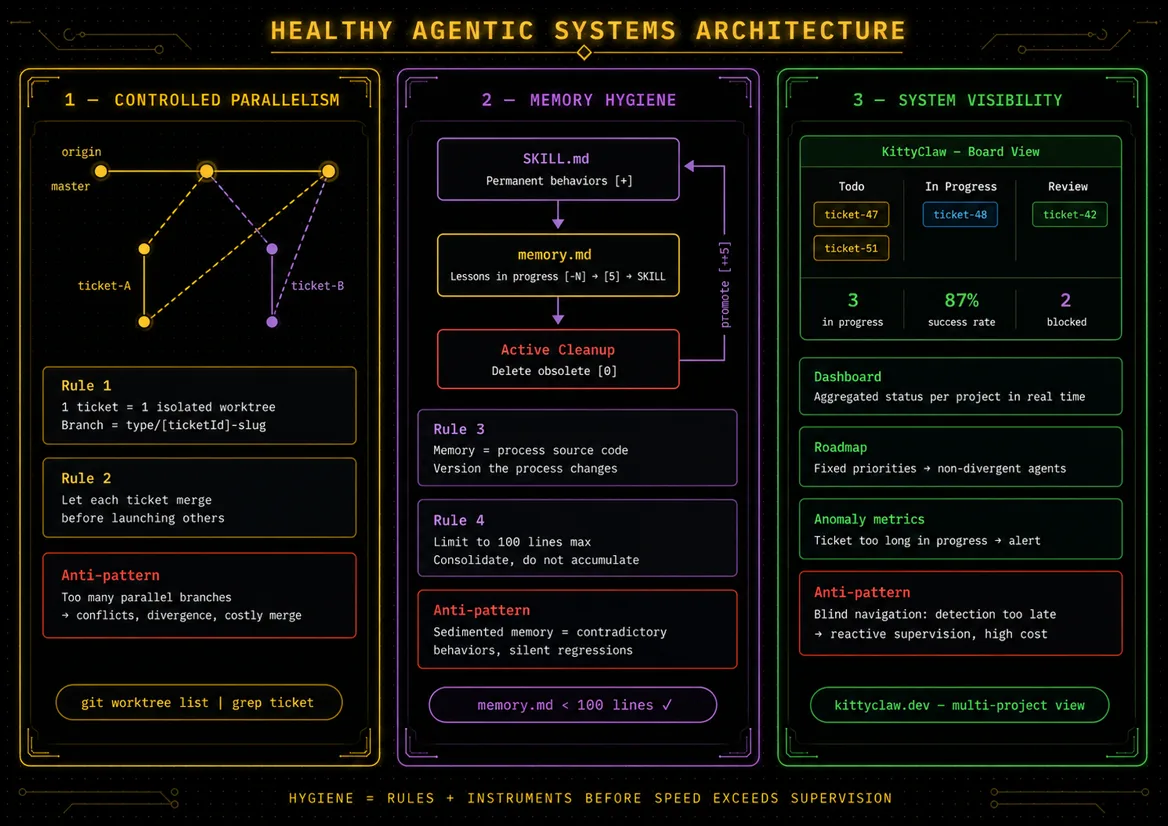
Trap 1 - Uncontrolled Parallelism
The temptation is real. While an agent handles one task, why not launch another? And then another. Agents don't get tired, they don't wait for meetings, they work without apparent friction.
The problem shows up at merge time.
Each agent modifies files, sometimes the same ones. Each worktree diverges from the trunk at its own pace. When the time comes to integrate everything back into master, conflicts pile up. Some changes contradict each other: one agent restructured something the other assumed was intact.
I tested two approaches with KittyClaw: all development directly on main, or one worktree per ticket. Neither is perfect. The first creates real-time interference. The second moves the problem to merge time.
The lesson: on a single project, don't go too fast. Give each development time to be evaluated through actual use before launching others. When the project has diverged too much, taking back control costs more than starting from a clean base.
Trap 2 - Memory That Resists Pivots
Multi-agent systems with persistent memory have a notable advantage: agents learn and improve across runs. They also have a symmetric disadvantage: they resist change.
When a process is deeply embedded in skill and memory files, changing it isn't enough. The old behavior keeps surfacing. The agent reads the new instructions but also the old memories, and ends up with two contradictory mental models. Sometimes it picks the wrong one. Sometimes it tries to reconcile both and produces something incoherent.
The practical consequence: mixed conventions in the code, scripts of uncertain status, regressive behavior after every process update. Entropy accumulates quietly.
The solution is to treat memory and skill files with the same rigor as source code. Actively delete what's obsolete. Don't accumulate. Version process changes clearly, with a date and explanation, so agents understand the old path is closed.
Trap 3 - Flying Blind
The cognitive cost of multi-project management is real - but it's compounded by an instrumentation problem.
An AI produces faster than a human can follow. When multiple agents work in parallel across multiple projects, the true state of the system becomes opaque quickly: what's actually in progress? What's blocked waiting for a decision? Which open branches haven't been reviewed yet? Without clear answers to these questions, supervision becomes reactive rather than proactive - problems surface when they're already expensive to ignore.
The solution isn't to slow the agents down. It's to equip yourself with navigation instruments.
Dashboards that give an aggregated view of each project: tickets in progress, tickets blocked, tickets in review, weekly progress rate. A roadmap that sets priorities and prevents agents from drifting toward unplanned areas. Metrics that flag anomalies: a ticket stuck in progress too long, a project that's stopped moving, a cluster of blockers on the same task type.
KittyClaw provides this visibility natively: per-project board, multi-project overview, complete traceability of every agent action. The difference between piloting with these instruments and piloting without is the same as the difference between instrument flight and flying by sight.
What This Changes in Practice
These three traps share a common structure: they appear when the agentic system evolves faster than the governance infrastructure around it. Parallelism without coordination, memory without cleanup, production without visibility - the same problem in three different forms.
Hygiene in agentic systems is defining early the rules and instruments that keep the system under control. Not after the damage is visible - before the agents' speed exceeds the human capacity to supervise.