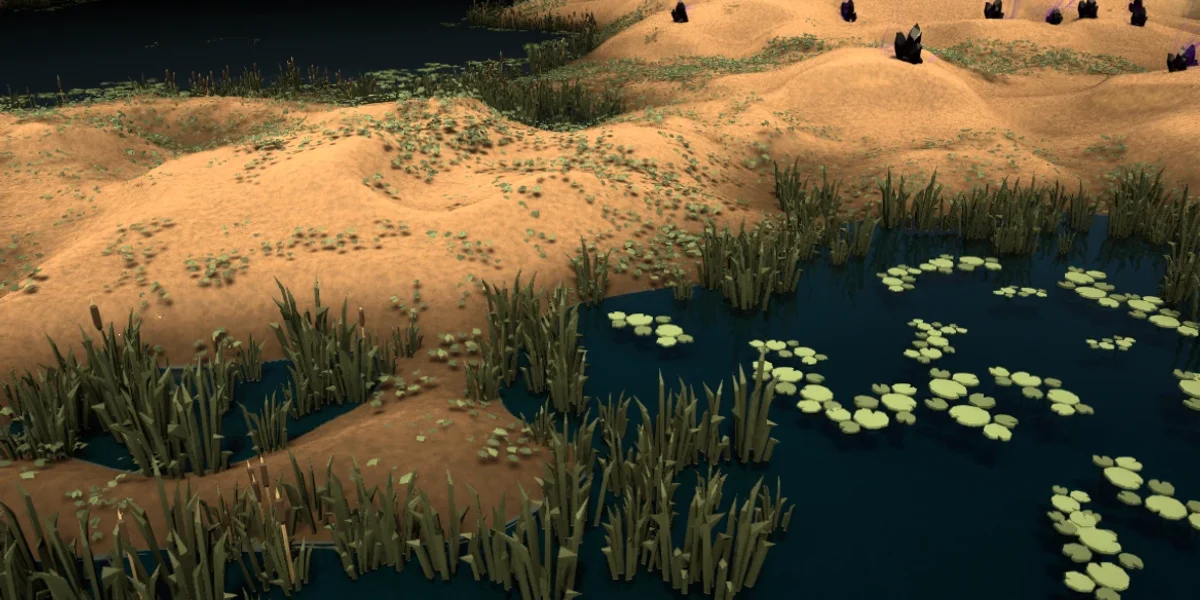
Welcome to a new devlog for Aekan: Call of Ruligon. If you're just discovering the project: Aekan is a procedural open-world exploration game where you play a truth seeker who can perceive and purify the corruption eating away at a living world. No traditional combat — here, you progress through understanding.
I started this prototype back in 2021. I laid the foundations — procedural generation, the first AI building blocks, the purification concept — and then the project went dormant. If you were following the devlogs on itch.io, that's where things stopped. Recently, I felt the urge to come back to it. The tools have matured, my vision for the game has sharpened, and most importantly, the drive is back. So I reopened the project, and things moved fast.
Here's what's been happening behind the scenes.
This piece documents Aekan: Call of Ruligon, a game project in the Ekioo universe. The broader ecosystem: Bloomii (constructive journalism), Kalceo (regulatory B2B SaaS), and KittyClaw (the kanban orchestrator for AI agents across all projects).
The world breathes
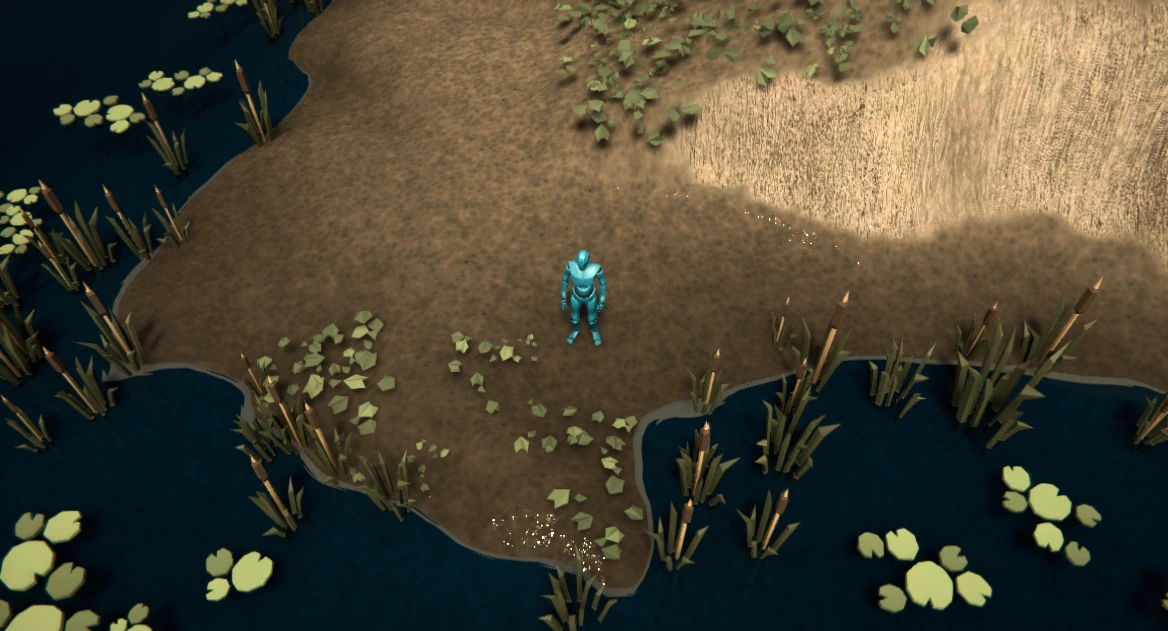
A procedural world is nice. A world that reacts to what you walk through is better.
I've rebuilt how the visual mood works in Aekan. Before, every influence source (a region, a corrupted crystal) tweaked the atmosphere on its own. The result: occasionally jarring transitions, effects stepping on each other.
Now everything flows through a centralized system. Concretely, as you move through the world:
- You enter a corrupted forest → the fog thickens, the hues shift gradually toward deep purple
- You approach a corrupted crystal → the mood intensifies further, the light changes — you feel the source before you see it
- You purify it → the visual influence slowly dissipates, the landscape recovers its natural colors, and the flora grows back little by little
- Two crystals close together? → their influences combine, creating especially oppressive zones
Everything is smooth, no cuts. The idea is that you shouldn't need a minimap marker to know a place is corrupted — the world shows you.
I'm now working on unique visual profiles per region type: each biome will have its own atmospheric signature, its identity through post-processing.
Corrupted crystals: the heart of the gameplay
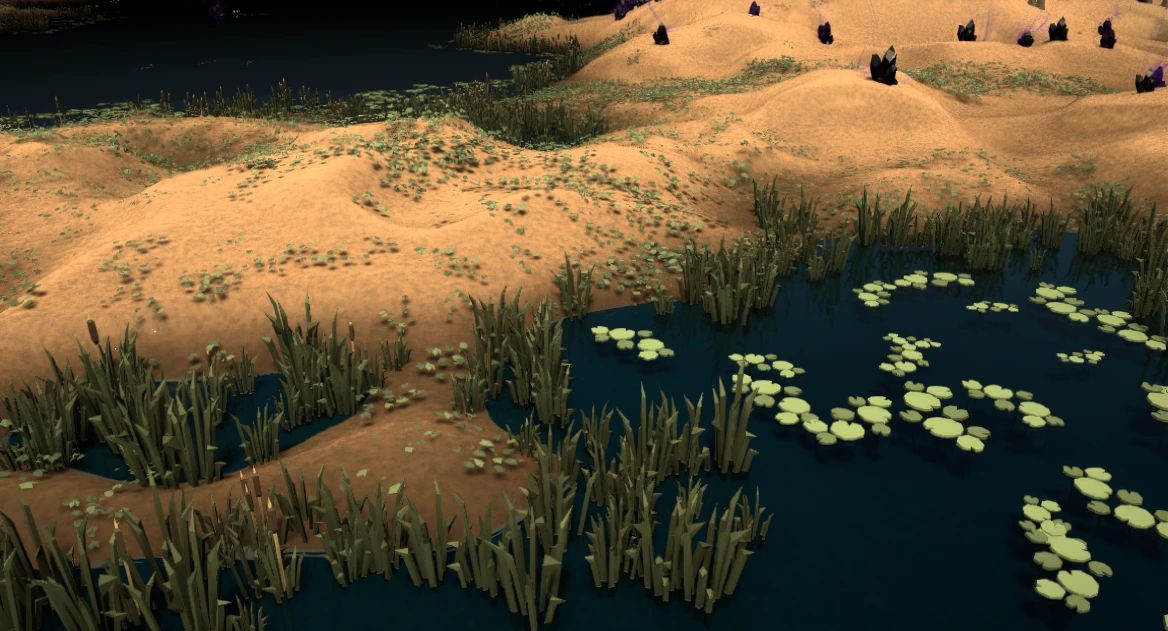
Corrupted crystals are the central element of the gameplay loop. They're the nodes of corruption you need to locate, understand, and purify.
They've been fully rebuilt to integrate with the game's entity system. Why does that matter for you as a player? Because it means each crystal exists as a real object in the world — it spawns naturally with the terrain, it interacts with its environment, and the world reacts when you purify it.
I also fixed a problem where vegetation and decor elements would visibly "grow in" when a new area was generated. That was immersion-breaking. Now, when a zone appears, everything is already in place — the trees, the rocks, the flora. As if the world had always been there.
The truth seeker takes shape
Until now, Aekan's world existed without its hero. That's changing: the main character is being integrated.
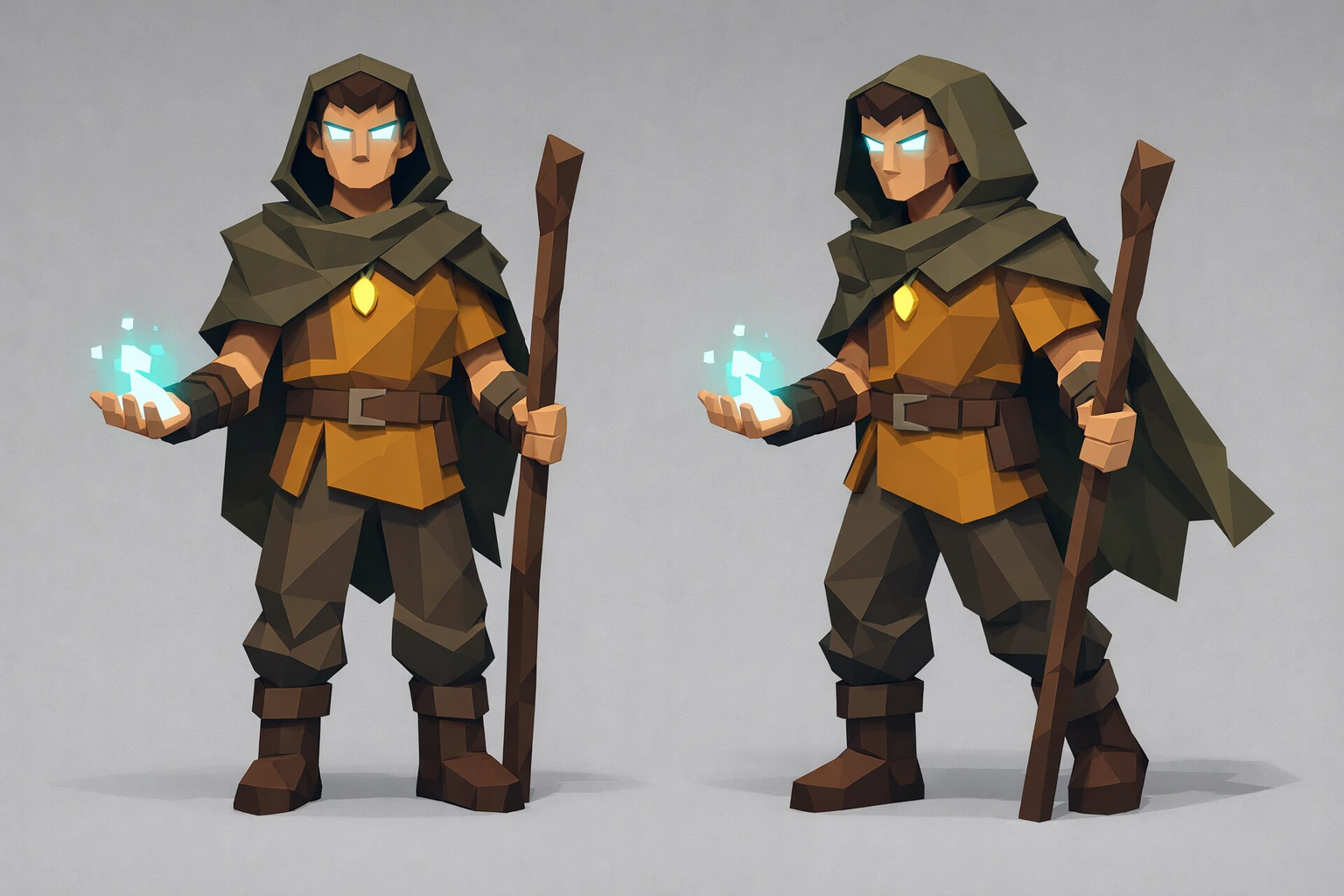
A hooded truth seeker, staff in hand, cyan gaze — a glow that reflects his ability to see the corruption where others perceive nothing. In his palm, a shard of purified crystal: the symbol of his power, and the heart of your gameplay loop.
The low-poly art direction isn't a default choice — it fits the visual coherence of the world: readable shapes, simple volumes, a palette that lets post-processing and mood tell the story. The character had to blend into that language without ever breaking it.
Next steps: rigging, a base animation set (idle, walk, run, channeling), then integration into the entity system so he reacts to the world's influences — the corruption that oppresses him, the purification that soothes him.
You know where you are
A small addition that changes a lot about the experience: when you enter a new region, its name appears on screen with an elegant fade, along with a subtle sound — something peaceful, evoking discovery.
It sounds simple, but it anchors the player in the world. Every region has a name, an identity, and the game takes the time to tell you. The names are localized — ready for multilingual support when the time comes.
A main menu that sets the tone
The main menu is in place. I wanted something that establishes the atmosphere from the launch: a polished scene with carefully crafted sound interactions (hover, click, confirmation). The SFX were composed to feel consistent with the world — soft, mysterious, inviting.
The atmospheric particle backdrop still needs finishing, but the foundation is there.
Unity Agent Bridge: AI-driven
One thing rarely shared in devlogs but that makes a real difference: internal development tools.
I built an agent that drives the Unity editor remotely — the Unity Agent Bridge. It can launch the game, simulate keyboard inputs, and inspect the state of entities in real time, all through an API. That's what lets me test complex scenarios (procedural generation, purification, region transitions) systematically rather than by hand.
Recently, I made it more robust: it stays responsive even when the game is running in Play mode with heavy generation, and it now has an endpoint to inspect any ECS component at runtime. It's the kind of invisible investment that pays off over time.
Fixes and polish
A few notable fixes:
- Teleportation: the
/movedebug command now properly repositions the player above the terrain — no more falling into the void - Performance: terrain texture loading has been optimized, and I'm working on spreading tile generation across multiple frames to eliminate micro-freezes
- Debug UI: I can now visualize the intensity of the world's influence fields in real time — indispensable for tuning the experience
What's next?
The prototype is moving forward well. The next steps:
- Finalize the narrative visual profiles — each region with its own unique mood
- Crystal channeling VFX — make purification visually spectacular
- Procedural generation of villages and landmarks — populate the world with unique points of interest to discover
- Wildlife and NPCs — bring the world to life with creatures and inhabitants
- Keep optimizing — the world is infinite, smoothness has to follow
Follow the development
If the project intrigues you, join me on Discord — that's where I share progress in real time, captures from the prototype, and where we discuss the direction of the game. Your feedback matters, especially at this stage of development.
See you soon for the next devlog.