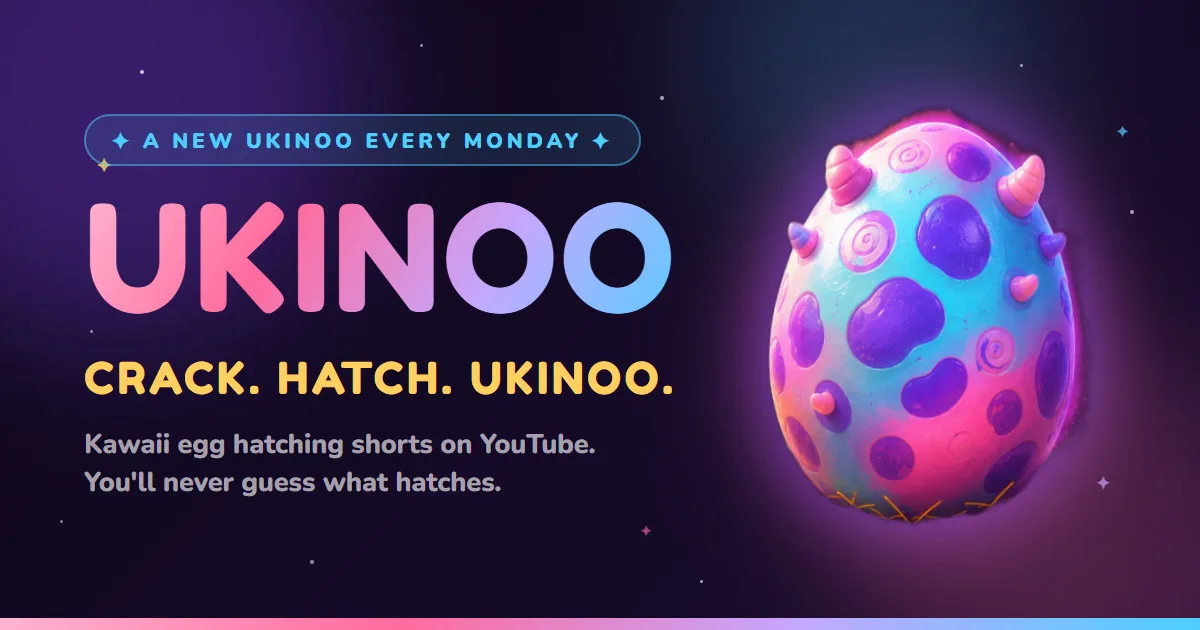
The Ukinoo bet fit into one sentence: what if a machine could design, produce, and distribute an intellectual property with very little human intervention?
This serialized video IP format suited the experiment. A multicolored egg appears, cracks open, and reveals a mischievous kawaii creature. Each episode can repeat the ritual with a new egg, a new character, and a new situation. Agents can propose concepts, write scripts, prepare images, generate the video, and organize distribution.
After several production cycles, the conclusion is encouraging but specific: Ukinoo validates an almost autonomous creation and distribution machine. It does not yet validate commercial success. There are no audience or revenue results that would justify conflating the two.
What Actually Scaled
A video IP is more than its final file. It needs an idea, a creative bible, a script, reference images, prompts, a video generation, a release date, captions, checks, and posts across several platforms.
Those intermediate objects are exactly what make automation possible. Once described as tickets, rules, and graphs, they can move between specialized agents. One prepares the concept, another writes the production package. Kinoboard, our internal video orchestration tool, then connects image and video generation before scheduling YouTube behind an approval checkpoint. A separate procedure finally picks up the video for the other networks.
The value is not merely generating a video. It comes from repeating an entire chain, preserving context from one episode to the next, and producing variations without rebuilding the process by hand.
First Lesson: Agents Amplify Their Foundations
At first, the publishing calendar was not a canonical source. Some creation tickets did not include an expected date, and Kinoboard scripts inferred one. Several episodes consequently received a wrong date, including a collision between two releases planned for the same Monday.
The problem was not that agents could not read a date. The system had not given them a single truth to read.
The fix was to make the foundations explicit: a shared calendar, a mandatory date in every brief, and a rule forbidding the generation script from inventing ytPublishAt. The ticket date becomes the canonical input, Kinoboard carries it through, and the dashboard makes it visible.
I draw a concrete lesson from this: in this pipeline, human ambiguity does not disappear through automation. It becomes repeatable. The faster the pipeline runs, the faster a vague convention spreads.
Second Lesson: Visual Continuity Is Still a Tradeoff
The video pipeline begins before the first prompt. The brief defines the creature, egg, setting, expected motion, and release date. The creative bible prevents the reuse of a combination that has already been published. Reference images then stabilize the elements that must persist through the episode, while the storyboard breaks the action into shots that can be generated.
Kinoboard turns this package into a graph. Three storyboard images are generated in sequence: the egg, the hatch, and the final scene. Together they feed a single 15-second video generation guided by three chronological beats in the prompt. The render then passes through a fade-out and waits at an approval checkpoint before YouTube scheduling. Variants therefore do not start again from a vague prompt: they reuse a versioned set of references and text.
Not every format uses the same path. Monday's hatch brings all three story beats together in a single generation. Wednesday's clip returns to the canonical creature image to build a short, loopable reaction. The visual anchor changes because the intent changes: narrating a birth in one case, immediately recognizing an established character in the other.
This is acceptable because useful consistency is not frame-by-frame perfection. The creature must remain recognizable, and each format should use the best available anchor. The production architecture has to adapt to the real model, not to the ideal model imagined in a diagram.
Before publication, a render is not merely marked "complete." Review covers creature and scene consistency, vertical format, framing and cover, text readability, audio, duration, transitions, and the absence of blocking artifacts. The approval checkpoint therefore separates a technically completed generation from content that is genuinely ready to publish.
Distribution Is the Real Last Mile
Generation naturally attracts attention. Yet the most fragile part of Ukinoo begins after the final render.
YouTube is integrated directly into the Kinoboard graph: video, metadata, and schedule are prepared together, while publication remains protected by an approval checkpoint. Distribution to the other platforms starts only after the source video is confirmed publicly available. Bluesky has a script-and-API path. For Instagram, X, and TikTok, the current procedure relies on automations tailored to each interface.
This does not look like a uniform publish(video) call. A distribution package brings together the correct file, its English caption, target link, and format constraints. Depending on the platform, the agent transmits that package through an API or controls the publication flow, stops at decisions reserved for the owner, and then checks the visible result. Requirements differ: crop and cover, final preview, visibility, or native confirmation can become release criteria in their own right.
The architecture works, but it has concrete failure points. Distribution is therefore handled as a state machine rather than a list of clicks. Each platform can be ready, published, verified, awaiting human action, or unavailable. A Gate prevents the next step from starting too early. If a channel fails, the pipeline preserves completed successes and resumes only on the missing destinations.
Idempotency is essential. Before each cross-post, the agent reads the account's public state and looks for the expected episode. After publication, it retains a public URL or native confirmation. This evidence prevents the system from confusing "the script finished" with "the content is visible," and it enables recovery without reposting everywhere.
That is what "almost autonomous" means. The agent orchestrates the procedure, checks media and metadata, preserves state, verifies idempotency, and knows how to resume. But the last mile still depends on direct interactions with platform interfaces and, at specific points, an explicit human decision.
From Organic Video to Merchandise
Ukinoo's model does not stop at organic video distribution. Each hatch also produces canonical visual assets, including the creature and its scene, that can become T-shirts, mugs, posters, or accessories in a Fourthwall store. The same creative pipeline therefore feeds both the content and its merchandise.
Fourthwall provides a useful API for creating some of these products, but it does not cover the entire job. Reliably placing visual assets on certain products still forces the Ukinoo pipeline to switch to interface control. That break makes execution less predictable than a fully API-driven path.
This is not an automation failure. It is a technical boundary that belongs in the workflow: the agent prepares the assets and products, uses the API when it is sufficient, and reserves the interface path for operations that are not covered.
Free Does Not Mean Costless
My intuition is that platforms are trying to contain the proliferation of automated channels while also dealing with genuine technical and security limits. I cannot assign them a single motive. For Ukinoo, the practical outcome is observable: the paths used do not cover the entire journey.
In my experience, paying for a third-party tool often means buying greater operational stability. For Ukinoo, the in-house solution saves the subscription but trades that saving for maintenance, checks, and recovery work. In this specific pipeline, API paths require less monitoring than interface-driven flows. A human step protects a sensitive decision but adds another availability and timing constraint.
The useful distinction is therefore not "automated" versus "manual." The real choice is where you pay: subscriptions, development, monitoring, or human intervention. For Ukinoo, that tradeoff is assessed channel by channel, based on achieved stability and recovery frequency.
What Ukinoo Really Validates
Ukinoo shows that it is possible to build a machine capable of imagining an IP, producing its episodes, creating variations, and orchestrating distribution with very little intervention.
The condition is demanding: the foundations must be explicit. You need a canonical calendar, ticket templates, structured prompts, a clear matrix of APIs and interface automations, duplicate prevention, recovery procedures, and approval checkpoints in the right places.
I am preparing an operational guide for project owners who want to build this kind of machine without any prior knowledge of Ukinoo. It will include a structured core guide, a step-by-step KittyClaw tutorial, a minimal example project with roles, workflow, ticket templates, and automation examples, launch and weekly operations checklists, and a section on mistakes to avoid drawn from this field experience.
The guide is available at a launch price of €19. Buy the operational guide on Ko-fi.
Ukinoo's current success is not a revenue curve. It is an engineering proof: an IP can now be born, evolve, and circulate through a largely agentic pipeline. The last mile remains imperfect. That is exactly where the interesting work begins.