
Imagine an ordinary dinner. One person talks about melting ice caps as if the world will end tonight. Another is convinced AI will erase her job within two years. A third has simply stopped following the news: "it's all going to hell anyway." Three people, three different apocalypses, same result: no one knows what to do with any of it. This fictional scene condenses the reactions that shaped my thinking.
I went home and looked for proof that they were wrong.
Not to deny the problems. But I had an intuition: somewhere, people had found answers. Not utopias. Things that work, documented, verifiable.
I found enough material to convince myself the intuition was right. To me, the problem wasn't the absence of solutions, but their lack of visibility.
Anxiety as a Byproduct of Information
A large randomized experiment on headlines published by Upworthy found that negative words increased click-through rates. Another study, cross-sectional and conducted with an Italian sample, observed that climate anxiety could be associated with more pro-environmental behavior while also being indirectly associated with eco-paralysis when self-efficacy decreased.
These findings do not explain our entire relationship with information, nor do they prove that a media narrative causes paralysis. They nevertheless reinforce my conviction that a gap can remain between perceiving a problem and knowing how to act.
Bloomii is an attempt to fill that gap.
The Choice to Document
The idea isn't to manufacture optimism. Not to find "good news" to offset the bad. It's more precise than that: finding proof of what works in domains undergoing deep change, such as ecology, technology, ways of living, health, and economics.
Regenerative farming practices. Energy cooperatives. Municipal mobility policies. These are subjects whose results, sources, and limits I want to examine without assuming their effectiveness in advance.
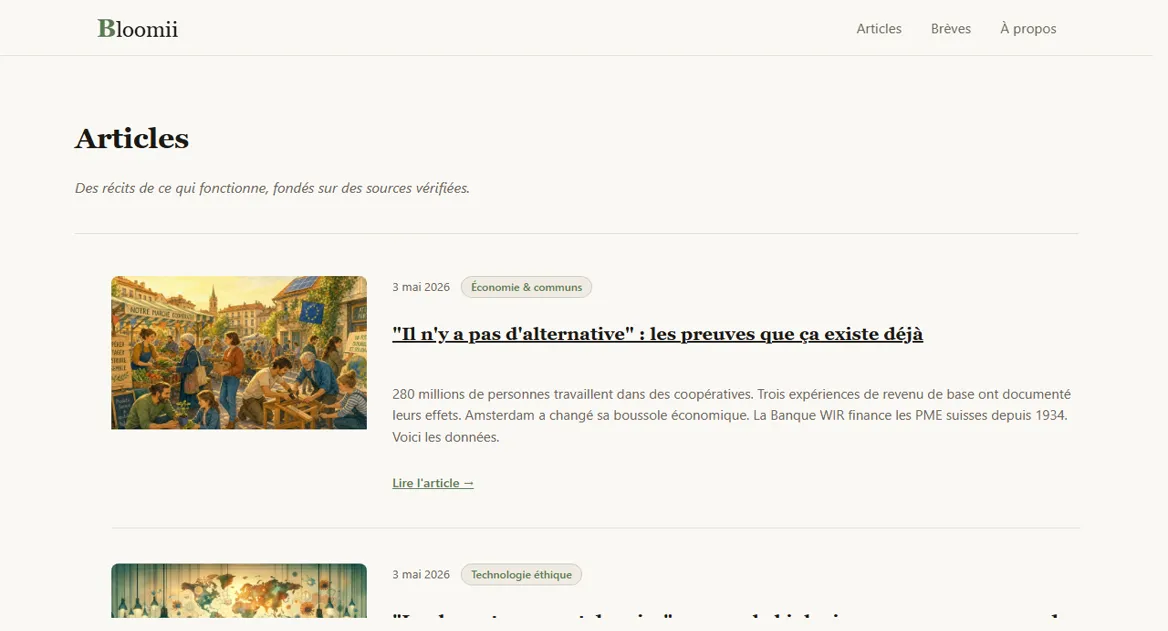
My editorial charter sets demanding criteria: do not present an isolated case as a universal solution, trace claims back to studies and official reports whenever possible, and seek out limitations as carefully as results.
I apply this filter the way I validate production code: if it's not verifiable, it doesn't ship.
Rigor as Conviction
As a developer, I've spent years building systems where approximations are expensive. In my experience, an assertion without proof in a test, a poorly documented dependency, or an untreated edge case always comes back. Rigor isn't a constraint in this profession. It's what distinguishes something that holds from something that collapses.
I apply the same logic to solutions journalism. Just because we want positive outcomes doesn't mean we can afford to be imprecise. On the contrary: if the goal is to document convincing proof, it needs to withstand critical examination. An article that oversells a result or omits its constraints does more harm than an honest, nuanced one: it feeds skepticism rather than dissolving it.
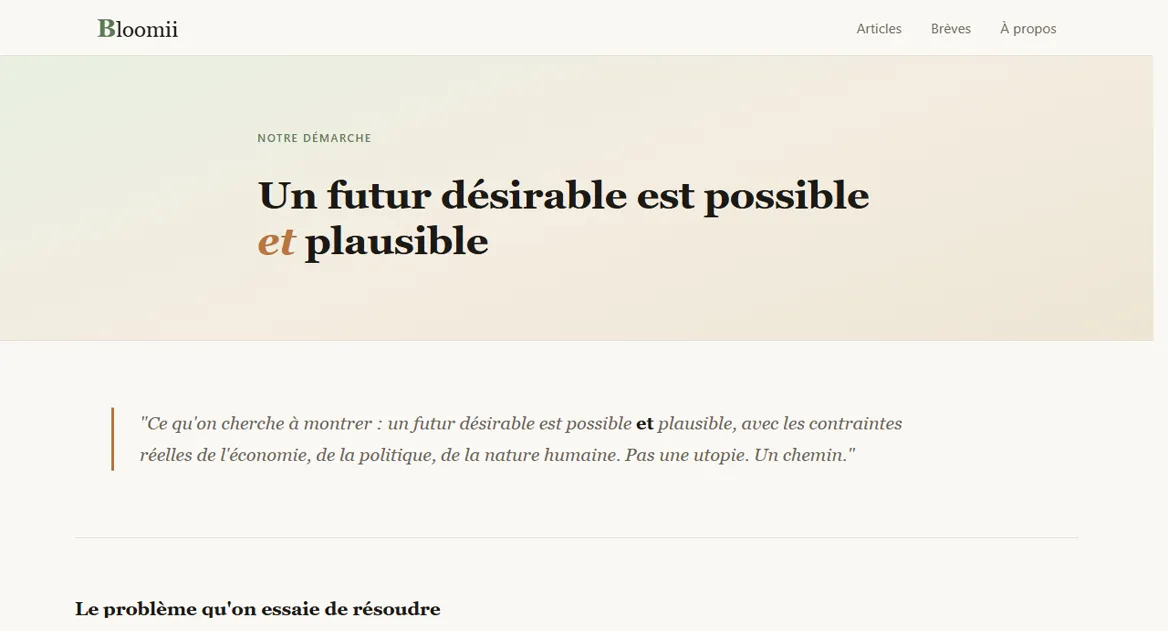
This methodological transfer between development and writing is central to the project. No shortcuts, no wishful thinking: building something that holds.
Why Now
I could have waited for a journalist to do it. In my search, I did not find a French-language publication that combined exactly what I wanted: documented solutions, a nonpartisan approach, and a strong standard for sourcing.
That observation raised an uncomfortable question for me: since I had the technical skills to build the information tool I was looking for, why wait for someone else to do it?
This isn't a heroic posture. It's a practical observation. We build the tools we need. Sometimes, the missing tool is a media outlet.
What Technology Makes Possible
Bloomii isn't a journalism project made possible despite technology: it's made possible by it. In my own practice, technology helps me manage a demanding editorial pipeline alone, publish consistently, and evolve the content structure.
Technology doesn't solve human problems on its own. It doesn't replace editorial judgment, field investigation, or primary sources. In my work on Bloomii, however, it reduces some repetitive tasks and helps me maintain this editorial pipeline on my own. I see it as support for my method, not as a substitute for a newsroom.
That's technology in service of people: not the pretension of automating what matters most, but the amplification of the capabilities of those who choose to use it for something useful.
Bloomii is a work in progress. The bet: documenting that it works somewhere is more useful than repeating that everything is going wrong everywhere.
For Bloomii, I use KittyClaw, a self-hosted kanban that orchestrates AI agents, to assist with selected steps in my editorial workflow. I remain responsible for editorial decisions and publication.